¶ Introduction
A power wheelchair is a wheelchair that is propelled by electric motors.

A mid-drive power wheelchair.
Operation of the chair can be done either by the person sitting in it, or an attendant behind it, if the chair is so fitted with such controls.
Power wheelchairs come in different classifications. Basic models are readily available in stores that sell accessibility equipment, or from popular online retailers. These chairs are not customized to the user, and are not likely to be covered by government or private insurance policies.
The highest classification, known as Group 3 in the United States, represents wheelchairs that have been custom designed for the user, and are considered to be durable medical equipment. As such, they are available to people to whom they have been prescribed.
A power wheelchair may undergo various modifications over time as it continues to serve the needs of an ALS patient. Attendant controls would not be fitted until the patient is unable to operate the chair themselves, for example.
¶ Start using when…
Walking longer distances is tiring or unstable

¶ Stop using when…
Light-duty chairs: the ergonomics of the chair no longer provide adequate support; driving the chair is difficult
Prescribed Group 3 chair: ∞
¶ Brands
Some major brands of power wheelchairs include:
- Permobil,
- Quickie
- Invacare
Power wheelchairs purchased through a government or private insurance program may not offer a choice in brand or model.
¶ Ergonomic Features
¶ Reclining backrest
The back rest on some models can recline relative to the seat pan. This helps reduce the angle at the hips.
¶ Seat tilt
The seat pan along with all other parts of the seat can tilt forward and backward on some models. Typically, the tilt will go very far rearward to support a lying position. Some models allow tilting forward (known as anterior tilt) somewhat beyond a level position to support helping to stand up from the chair.
¶ Seat elevation
Seat elevation is a feature that raises and lowers the seat. The range of motion varies from model to model.
Benefits:
- at its highest extent, it can put the head at nearly the same height as if the individual were to be standing
- raising the seat can be beneficial when interacting with others that are standing
- the seat can be raised and lowered to be higher or lower than other surfaces, such as beds or toilets, to allow use of a transfer board in a downhill inclination
- the seat height can be adjusted to accommodate tables of different heights
- caregivers may benefit from an increased elevation when providing assistance, such as putting on shoes or nail cutting
Drawbacks:
- high cost
- many insurance companies and government accessible device programs consider seat elevation to be a non-essential feature
- the lowest extent may still be too high for head clearance when entering a wheelchair van or other confined space
¶ Leg and foot rest elevation and angle
The leg rests and foot rests can be raised and lowered on some models. This adjustment allows for changing the amount of pressure placed on the legs by the seat pan, especially under the knee.
The leg and foot rest angle can be changed to support different angles in the knees. Leg rest elevation often needs to be changed when changing the angle of the leg rests. The foot rests need to become ever further away as they raise up to match the individual's body geometry.
The foot rest angle relative to the leg rests is typically not adjustable using power controls; there are small set screws that change the angle between the foot rest and the leg rest.
¶ Arm rest adjustment
Arm rests can be repositioned vertically, horizontally, and their angle of inclination from front to rear. In some cases, the arm rests may need to be moved inward to allow the wheelchair to fit through narrow doorways.
¶ Operation
¶ Controls
Power wheelchairs may be controlled by the occupant, or an attendant using an external control pad.
Occupant controls come in the following varieties:
- hand-operated joysticks; power chairs almost universally include a joystick for operation, even if other systems are installed
- chin- or head-operated joysticks
- sip-and-puff controls
¶ Performance
Power wheelchairs vary in terms of performance. Faster models are associated with increased costs. Insurance and government coverage plans may have a limit on which models are available, as a high-performing wheelchair would not be considered essential.
It can be an advantage to have a wheelchair capable of high speeds; speeds above 7.5 mph (12 km/h) allow for keeping up with companions that are running, or riding a bicycle or scooter. A higher top speed is also associated with having a larger useful travel distance.
¶ Best Practises
Power off the wheelchair whenever it is not actively being driven. The user or other people and objects may bump into the controls, causing undesired operation.
Wear the seatbelt restraint at all times. This is especially true in outdoor settings; hitting a small bump at a low speed may still be enough to cause the user to fall out of the wheelchair.
Do not apply significant pressure to the arms of the wheelchair during transfers. They are not designed to bear the weight of a human being.
Avoid steep edges of sidewalks. When driving down a sidewalk with a companion walking alongside, the companion should be closer to the road, and the wheelchair on the opposite side. This reduces the risk of the wheelchair dropping a wheel off of the sidewalk and falling onto the road.
Drive slowly indoors and in confined spaces. The wheelchair should be placed in the lowest speed setting when indoors, and when pulling up to a destination such as a table.
Charge the chair in a well-ventilated area. The batteries in a power wheelchair may emit toxic gases while they are being charged. It is not recommended to charge them in a small room or in a room with poor ventilation.
¶ Transportation
¶ In an accessible vehicle
An accessible vehicle is the most sensible way to transport a power wheelchair with or without the patient in it.
¶ On a bumper rack or basket
Power wheelchairs can weigh well over 450 lb (205 kg). Most vehicles are not rated to have anywhere near this much weight applied to the rear of the vehicle. The maximum tongue weight rating of a vehicle is typically 10 to 15% of its rated towing capacity. A small sedan may have a towing capacity of 1000 lb (450 kg), giving it a tongue weight rating of 150 lb (70 kg) at best.
Larger vehicles, such as full-size SUVs and pickup trucks would be able to transport a power wheelchair in this way.
¶ Into a pickup truck bed
The elevation of the tailgate on a full-size pickup truck such as a Ford F-150 or Chevrolet Silverado can be as high as 36 inches (91 cm). This causes the angle of a loading ramp to be extremely high; higher than what a power wheelchair is rated to climb when occupied.
An 8 foot (244 cm) ramp going up a 36 inch (91 cm) bed elevation would be at an angle of inclination of 22°.
See also: Ramp Angles
It is possible to drive an unoccupied power wheelchair up a very steep ramp into the bed of a full-size pickup truck. However, extreme caution must be taken to ensure that the ramps stay in position and do not slip off the edge of the tailgate or slide out of position laterally. The longest possible ramps should be used.
Never attempt to manually push a power wheelchair up a ramp into the bed of a pickup truck.
¶ In a trailer
A power wheelchair could be loaded into a utility trailer that has a cargo capacity appropriate for the wheelchair's weight.
The wheelchair would have to be fastened just as firmly in a trailer as it would be in an accessible vehicle. Many trailers lack adequate tiedown points. Heavy-duty straps would need to be used.
¶ Maintenance
¶ Battery Replacement
The batteries in a power wheelchair will inevitably provide less and less electrical power, and thus range to the wheelchair.
Most power wheelchairs use AGM lead-acid batteries, similar to those found in automobiles or boats. However, the terminal connectors may be proprietary and require adaptation if aftermarket batteries were to be used.
Batteries of this type are categorized into size groups, such as "Group 24". Wheelchair batteries are sometimes slightly smaller than the standard dimensions for their designated size group. Other batteries from the same size group may not physically fit in the wheelchair's battery compartment as a result.
¶ Common Problems
¶ Broken Joystick
Joystick controls are prone to breaking due their vulnerable position on the wheelchair, and their tendency to be abused by the user or assistants.
The joystick should be operated gently; only a very small amount of force is required to operate it.
The joystick should never be used as a hold by an assistant when they are near the wheelchair.
No object should be placed on top of the joystick, including blankets.
¶ Caster Flutter
Caster flutter is a phenomenon where the caster wheels shake back-and-forth while underway. It is caused by forces from the road acting on the caster in a manner which causes them to resonate and shake on their own, much like a flag flapping in a stiff breeze. Large bumps or even small grooves in pavement can cause caster flutter, especially when travelling at high speed.
Caster flutter can be stopped by decreasing the speed of the wheelchair. It may be necessary to bring the wheelchair to a complete stop before it fully recovers.
Power wheelchairs are fitted with anti-flutter clutches in the kingpin of each caster. These clutches may wear out and fail over time, especially in extreme conditions. In some cases, they may be in good service, but not installed correctly; a simple tightening of the kingpin bolt may be enough to mitigate caster flutter. Care should be taken to avoid over tightening the kingpin bolts as it may cause them to break.
Caster flutter which continues to occur in the long-term will eventually cause extreme tire wear and eventual failure of the tire.
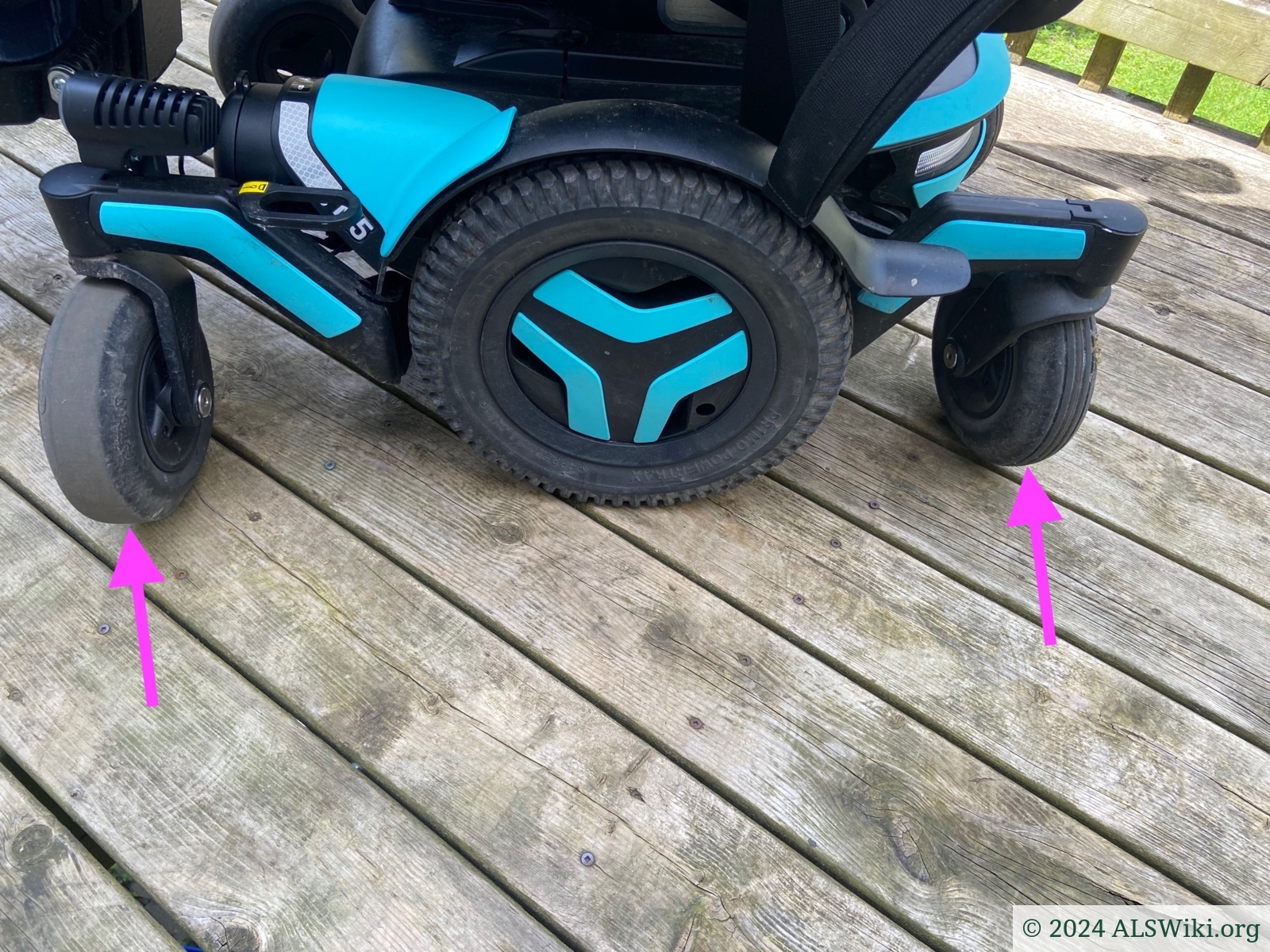
Wheelchair with severely worn front tires due to caster flutter
¶ Worn, Damaged or Punctured Tires
Drive tires and caster tires should be inspected periodically, and replaced if worn or damaged.
Many power wheelchairs are fitted with tires with a foam core instead of an air tube. The tire should be replaced if the foam becomes visible from the outside.
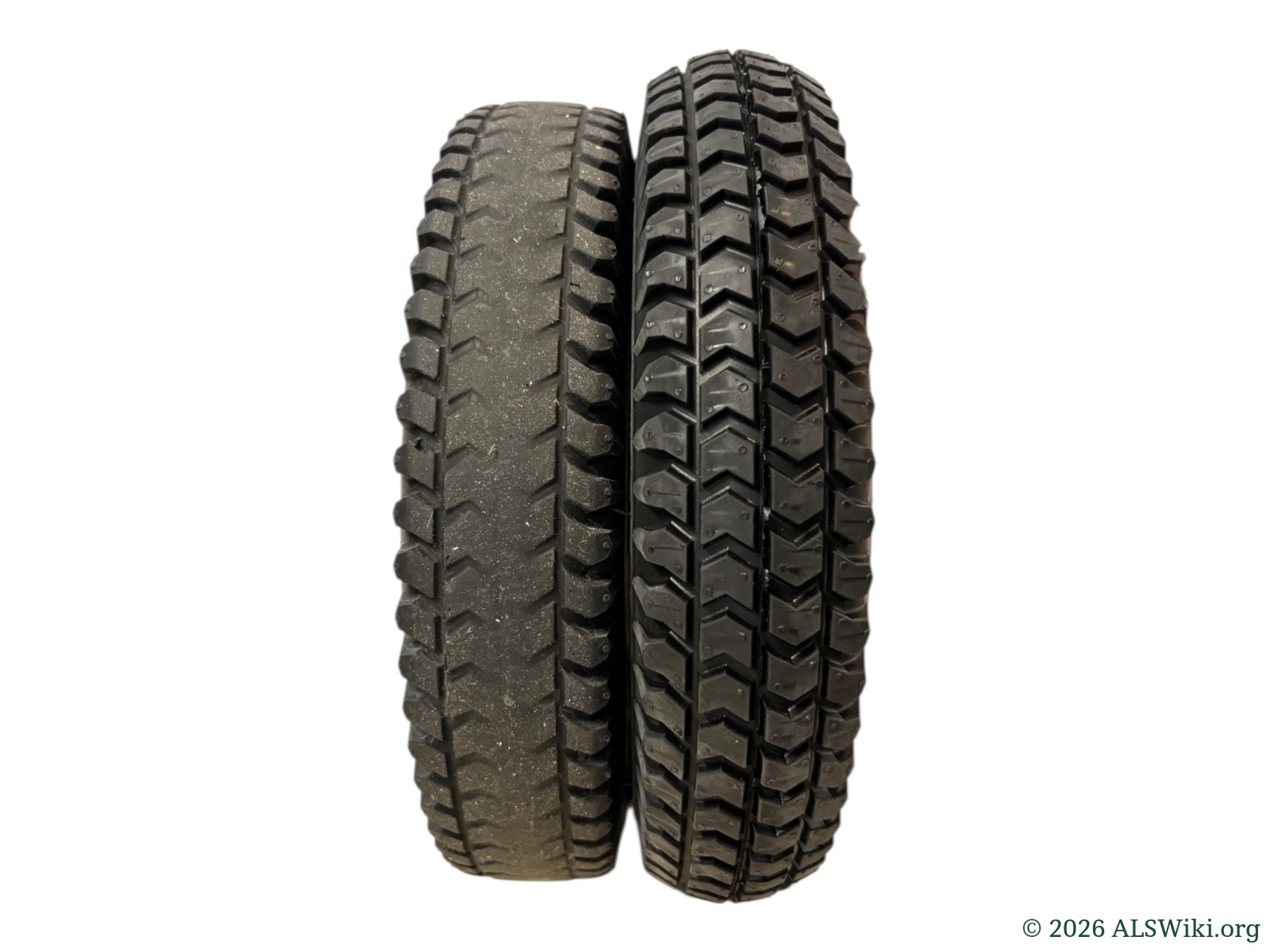
Severely worn drive tire, left, beside a new tire, right.
¶ Further Considerations
Power wheelchairs are heavy. Power wheelchairs can weigh up to 750 pounds (340 kg) when the occupant is in it. This may be higher than the weight rating of some aluminum folding ramps.
Power wheelchair parts can be difficult to acquire for private individuals. Dealers must be contacted in most cases.
Power wheelchairs are strictly regulated. Many features are kept behind lock and key, such as the ability to set programmed position settings. Licensed dealers are the only people permitted to change most advanced settings on a power wheelchair.
Resale value is difficult to predict. Prescribed models are customized to the patient; it would be extremely difficult to find a buyer that has comparable needs, and also does not have the means to get a new one for themselves. On the other hand, it may be possible to sell the wheelchair to a buyer in a different region, where their ability to get their own may be difficult.
¶ Power Wheelchair Quote
Title: Power wheelchair quote – PDF
Description: Complete quote for a Permobil M5 power wheelchair for an ALS patient
File type: PDF
File size: 3.3 MB