¶ Introduction
Reduced mobility and increased care needs necessitate the ability to communicate within the home with minimal effort. Tasks such as signaling for help and answering the door are important and must be easy to do.
¶ Smartphones
Smartphones can be used within the home to communicate using voice, video, or text.
Video communication can be useful in circumstances where the disabled individual needs to see a room or area of the house that they are not able to access on their own. The assistant can use their own phone camera to look around on behalf of the other person.
Text communication can be useful when the patient's need is not urgent and can be dealt with when the assistant has a spare moment.
¶ Call Bells
Call bells are a simple and affordable tool for in-home communication. Many call bells are sold with multiple transmitters and receivers. The receivers should be placed in zones where caregivers will be able to hear them easily, while transmitters should be placed within easy reach of the individual that needs them. It is best to have one that is always with the individual themselves, while others can be kept in fixed locations such as the bedside, or near the toilet.
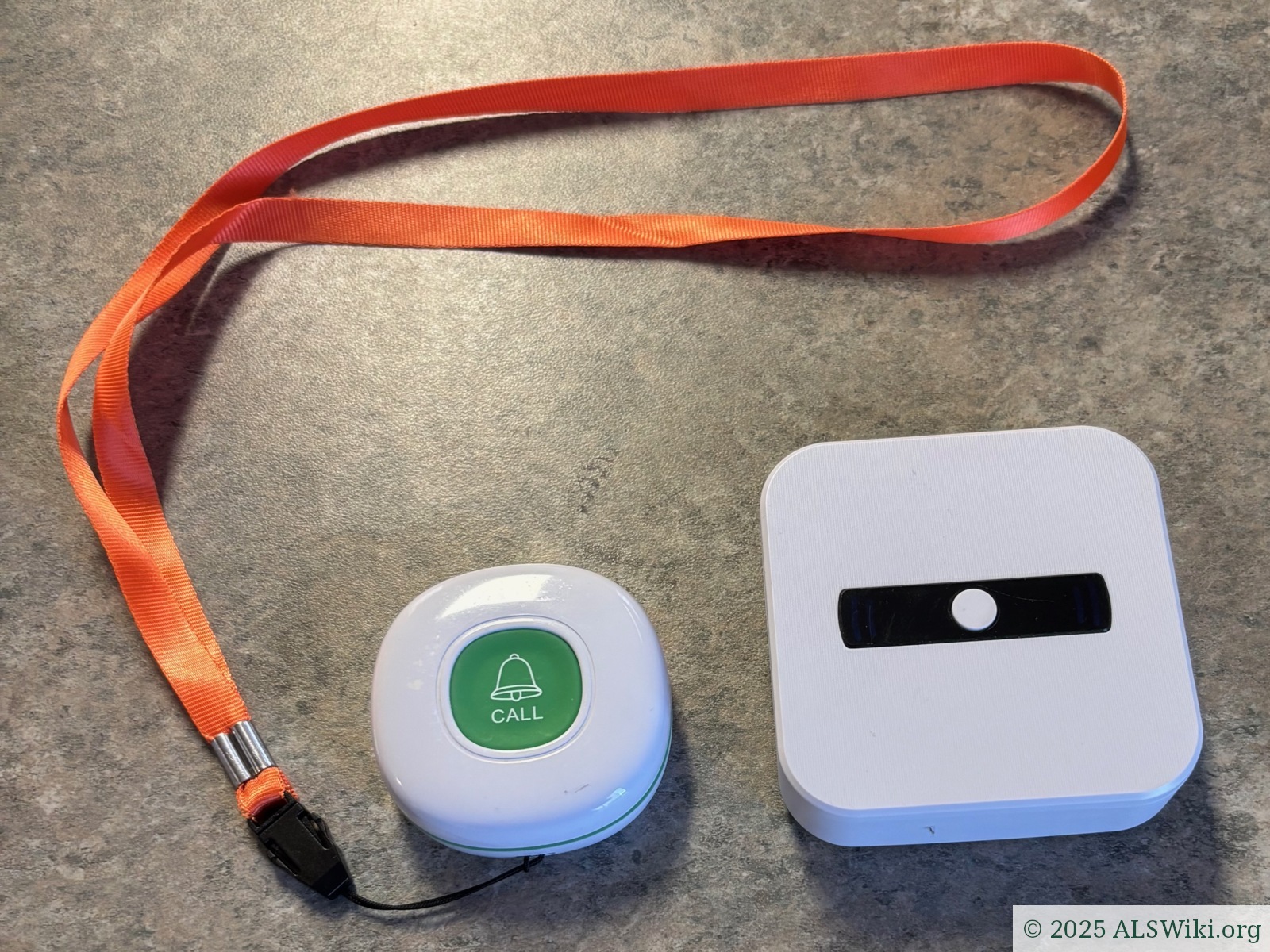
Call bell transmitter (left), and receiver (right).
Call bells vary in cost and complexity. Many available features are quite useful. Such features include:
- audible alerts when the batteries are weak
- distinct ringtones based on which transmitter button was pressed
- blinking lights on the receiver
Call bells should be tested periodically and their batteries replaced in advance of when they typically lose sufficient charge.
¶ Smart Doorbells
Smart doorbells allow interacting with people at the front door of the home without having to get to the door in a timely manner. Smart doorbells interface with smartphone apps, and desktop web browsers in some cases.
Friends, family, and recurring visitors can be educated about the inability to answer the door, and to simply knock and then let themselves in. However, delivery drivers, door-to-door solicitors, and other people unfamiliar with the home are likely to give up and leave if the door is not answered in a timely manner.
¶ Further Considerations
The patient should not abuse the communication system. Avoid calling for help repeatedly when the needs are not important. Instead, wait a bit and try to combine calls into larger requests when possible.
Caregivers should never ignore a call. The patient may often use the call bell or smartphone around the same time each day for the same things. However, serious problems such as choking or falling can happen at any time. Always respond to communications from the patient.
It must be possible to hang up a smartphone. If the patient uses a smartphone to call a caregiver, the call may be missed and go to voicemail. If they cannot hang up on their own, they must wait out the voicemail recording limit, which can be as long as five minutes.
Test the communication system frequently. Systems which are rarely used may fall out of service without anyone noticing. The patient may have lost the physical ability to operate the communication system since the last time they used it. This is especially true with call bells that are to be used while lying in bed.
Test the communication system after power outages or device reboots. Some devices, especially smart devices, may lose their configuration after a reboot. A login may also be required.