¶ Introduction
Patient lifts are devices that are used to transfer an individual from one seated or lying position to another, such as from a bed to a wheelchair.
Slings are used in conjunction with patient lifts to support the patient. They come in a variety of styles which are optimized for different positions and uses, such as toileting.
An individual with ALS will need to use a patient lift to transfer between beds, wheelchairs, and so forth once they have lost the ability to perform such transfers independently, or with the assistance of a transfer board or another person.
The need to use a patient lift is often a significant milestone in the course of the disease. It is common for individuals to resist the use of a lift for a variety of reasons, such as concerns about safety, unfamiliarity with its operation, or resistance to accepting that the use of such equipment has become necessary.
Lift transfers can be performed relatively quickly if the equipment is kept organized, and the assistant is well-trained. In some cases, lift transfers can be faster than complex alternative methods, such as a slow trip across a transfer board with many breaks taken along the way.
¶ Start using when…
It is no longer possible to do a transfer independently, or with a transfer board

¶ Stop using when…
∞
¶ Patient Lifts
Patient lifts come in a few different forms:
- Hoyer lift, or simply floor lift: a portable lift with wheels
- Ceiling lift: a sliding track that is suspended overhead by the joists in the ceiling of the building, or held up by large columns
- Sit-to-stand lift: a portable lift used to help stand up from a sitting position
- Pool/bath lift: a specialized lift designed specifically for transferring to a pool or a bath, and is able to withstand exposure to water
¶ Ceiling lifts
Ceiling lifts come in a few different forms:
- Ceiling-mounted: the ceiling track is fastened directly to the ceiling
- Pressure-fit: the ceiling track is supported by at least two columns, which are extended to put pressure against the ceiling and the floor to maintain position
- Freestanding: ceiling track is supported by at least two columns, which are kept upright by large feet
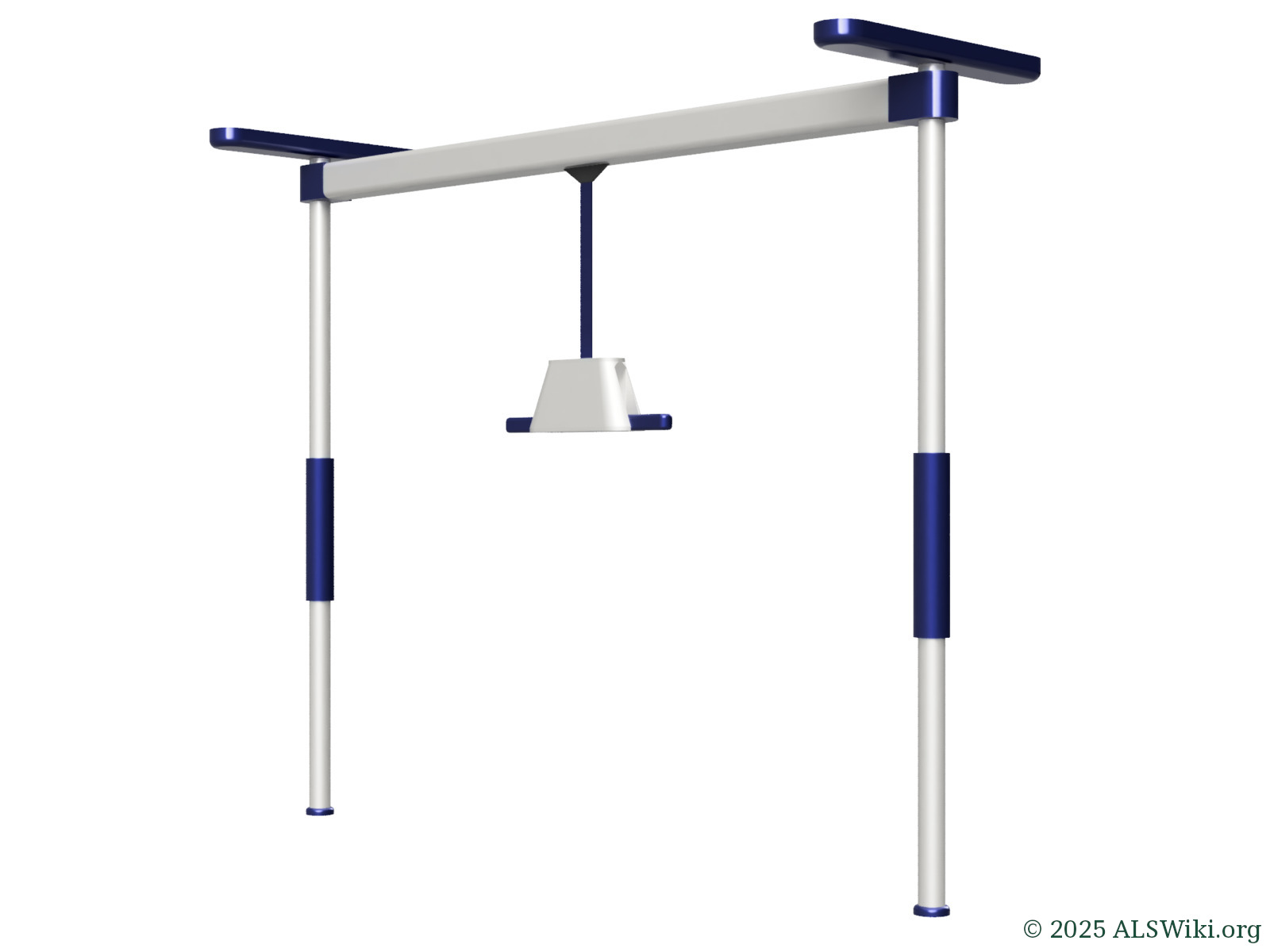
Ceiling track lift that is supported by columns which are pressed firmly into the ceiling and floor.
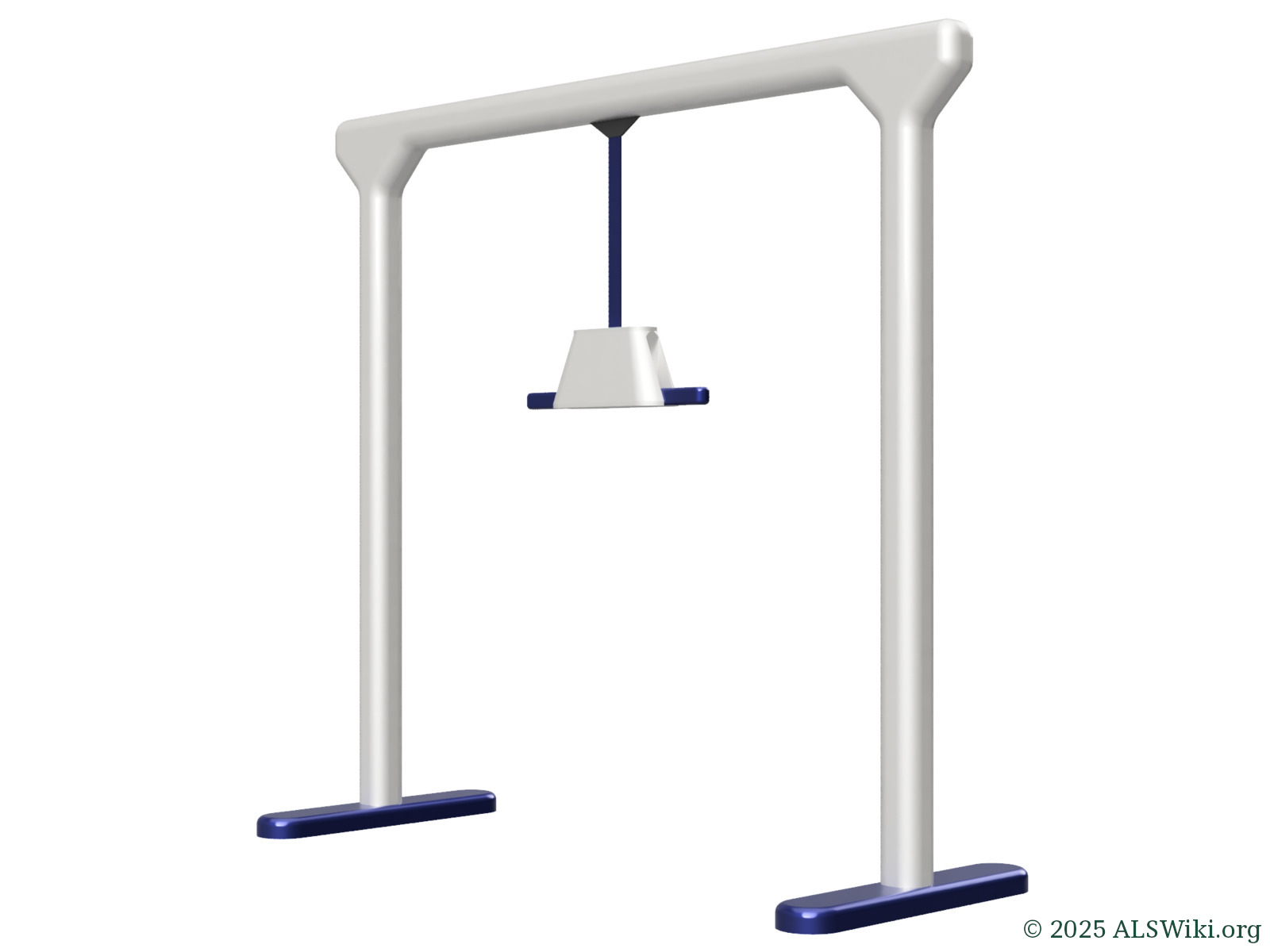
Ceiling track lift that is supported by columns which have large feet on the floor to provide stability.
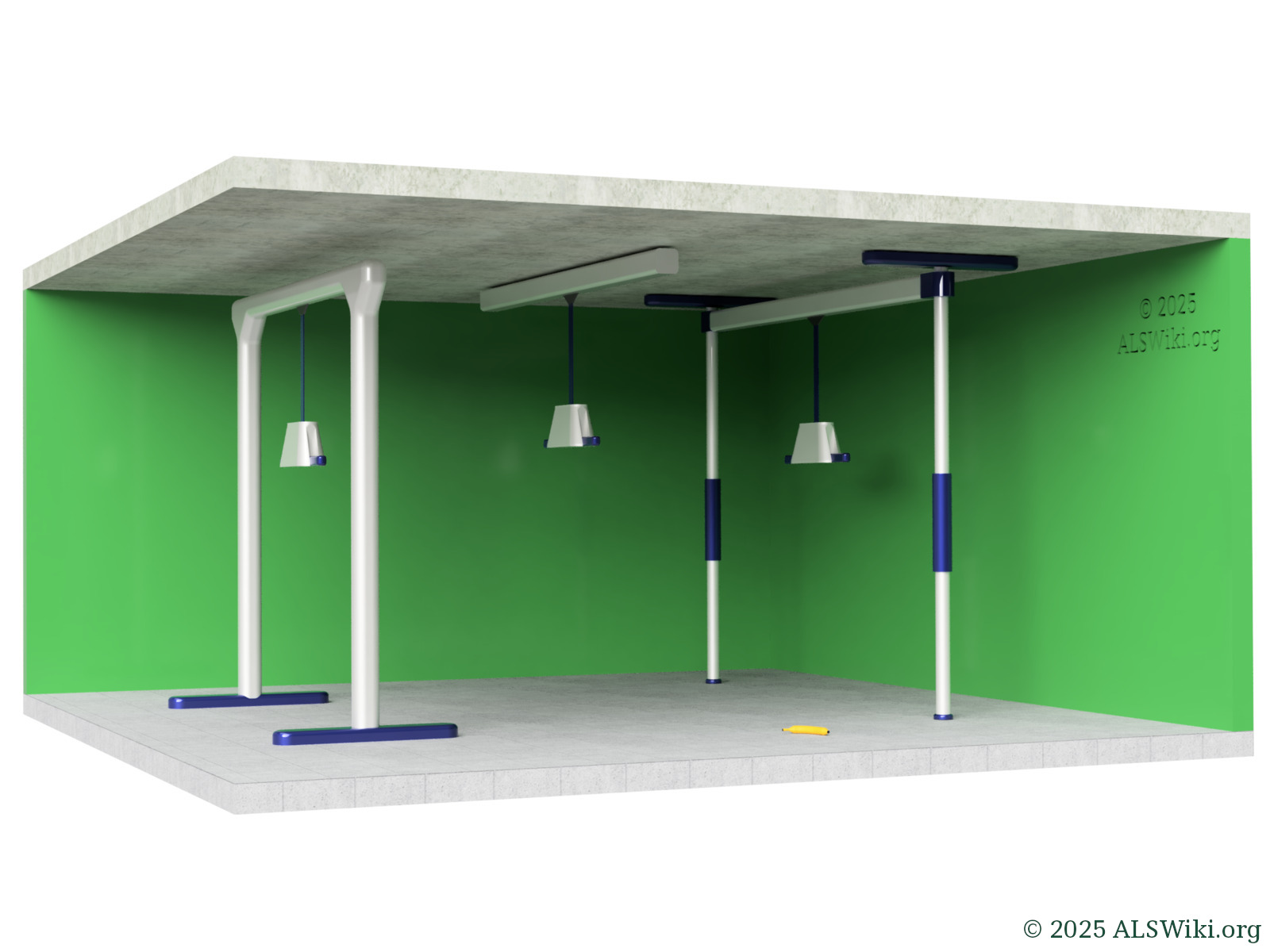
Rendering showing three types of ceiling lifts: freestanding, ceiling-mounted, pressure-fit.
Note the varying heights of the tracking, and the amount of floor space used by each.
¶ Benefits
Preservation of floor space. Models which fasten into the ceiling use no floor space at all. Floor lifts use floor space when in use, and also when stowed.
Consistent, repeatable transfers. A patient can be placed in the exact same spot at the destination every time when positioned properly relative to the lift tracking. This also makes transfers faster.
Minimal effort needed to operate. The only step of the transfer that requires manual movement is pushing the patient along the tracking, which is generally quite easy. Floor lifts must be moved to complete a transfer; they have small wheels which can make movement difficult.
Not impacted by flooring. Models which fasten into the ceiling are not affected by the material used on the floor, such as tiles or carpeting, which would not be suited to a floor lift.
¶ Drawbacks
Lack of portability. Models which fasten into the ceiling are not at all portable. Models which are supported by columns may have some degree of portability, however, they still must be disassembled and reassembled. Floor lifts typically have simple release mechanisms that fold them up in a matter of seconds.
Rigid transfers. A ceiling track lift can only transfer the patient directly below where the tracking goes. Floor lifts on the other hand can move the patient anywhere in the room.
Higher cost. Ceiling lift systems are fairly expensive. Intricate tracking systems which allow movement along two dimensions, or through doorways and so forth can cost tens of thousands of dollars.
Some systems require professional installation. Only freestanding and pressure-fit systems are marketed as being suitable for setup by the end-user.
The building may not be suited to accept a ceiling lift. Ceilings which are very low will prevent successful use of a ceiling lift. Ceilings which have engineered floor joists require very specialized installation.
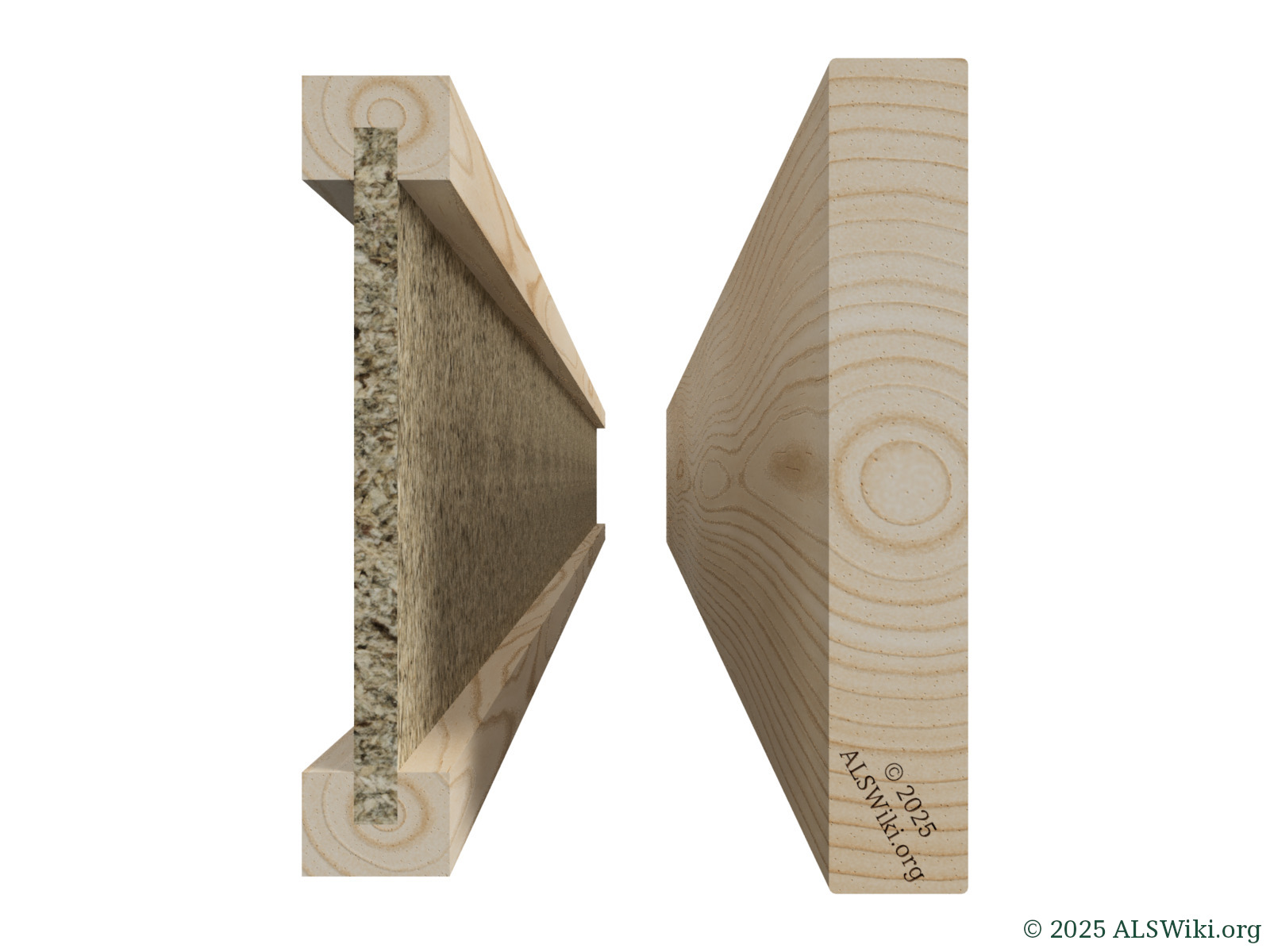
Mounting ceiling lift tracking to engineered floor joists (left) requires specialized installation. Installation onto solid joists (right) are simpler.
¶ Floor lifts
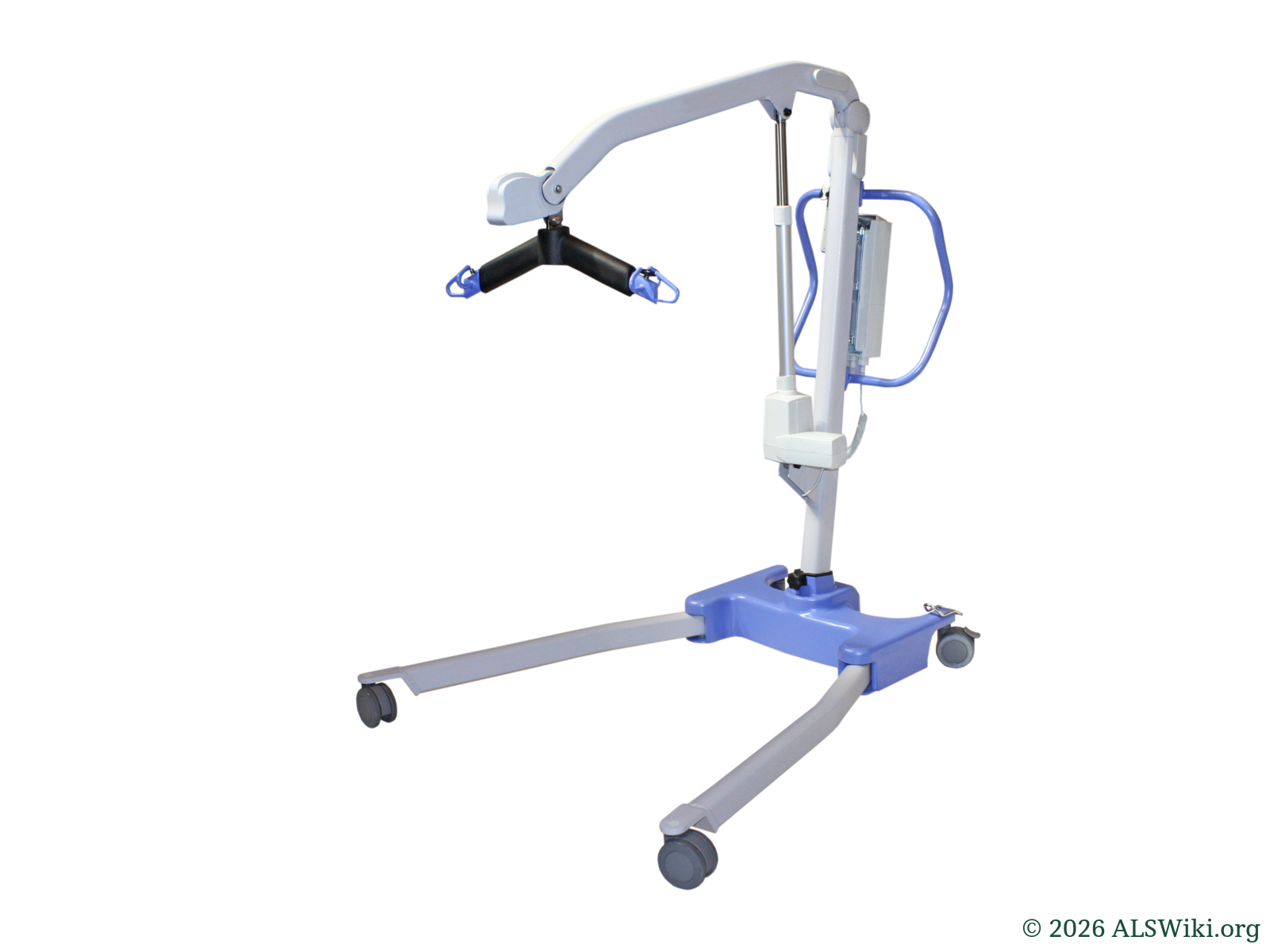
A typical floor lift.
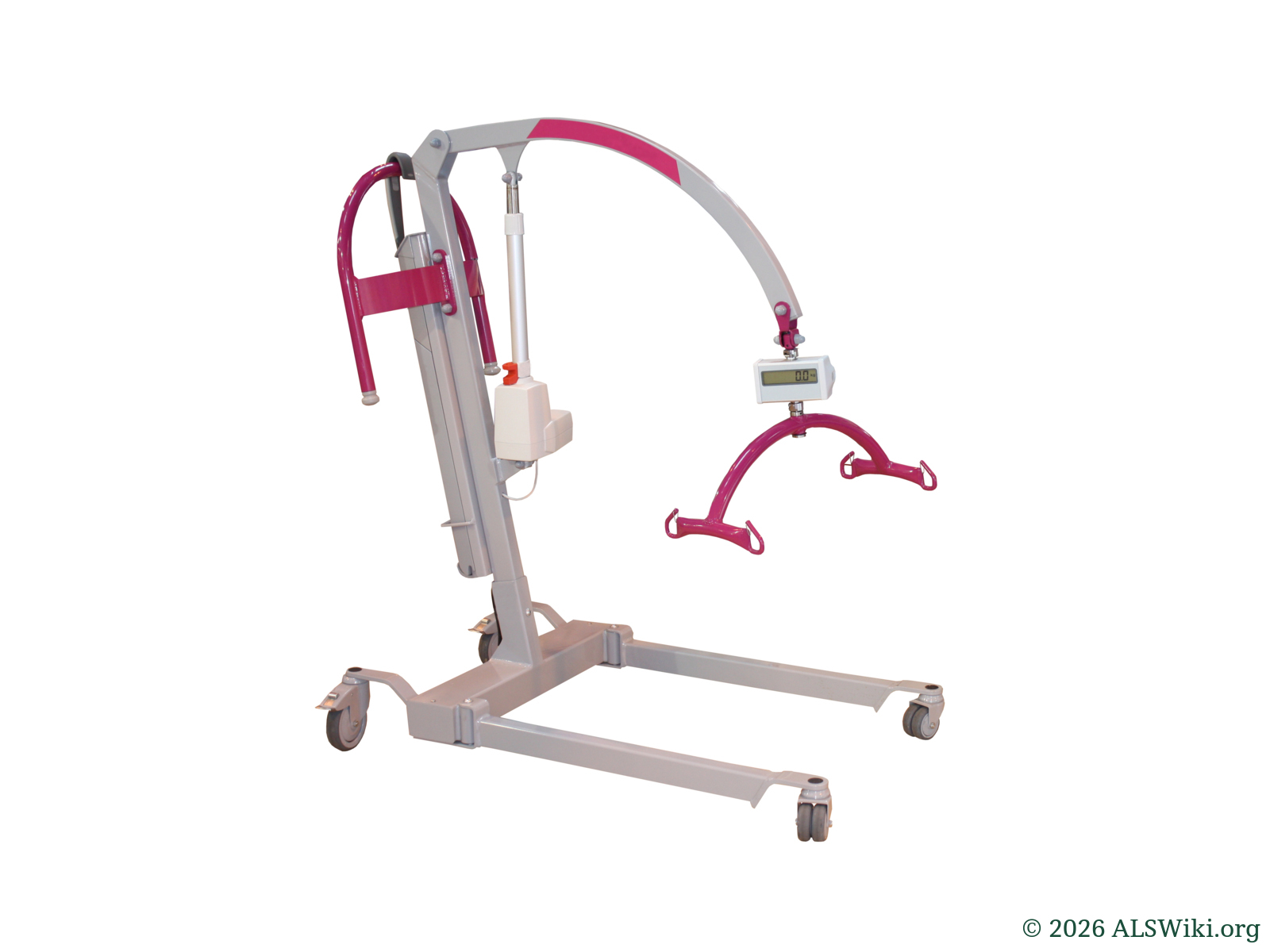
A floor lift with integrated weight scale.
¶ Benefits
High portability. Most models have quick release pins and latches that allow folding in a matter of seconds.
Lower cost. Floor lifts are generally much cheaper than ceiling lift systems.
Greater flexibility with transfers. Floor lifts can be maneuvered anywhere in the room; ceiling lift systems can only raise and lower the patient directly below where the tracking goes.
Not impacted by construction of the building. Floor lifts are not affected by the height of the ceiling, or how it is constructed.
¶ Drawbacks
Consumption of floor space. Most models have features that allow retracting the legs to reduce how much space they use, however, this does not completely alleviate the problem.
Having to step over the legs of the lift. The attendant must step over the legs of the lift several times during a transfer. This increases the risk of tripping.
Sensitivity to floor surface material and condition. Floor lifts are harder to use on surfaces that are not smooth and flat. Deep-pile carpet is not suited for floor lifts.
Less consistent transfers. Use of a floor lift means having to accurately position the patient when landing at the destination. For something like a wheelchair, this is simple as the landing area is small. For a bed, some amount of practice is needed to be able to establish where to place the patient each time. This makes floor lift transfers on average slower when compared to ceiling lifts.
Higher effort needed to operate. The floor lift must be moved from the point of origin to the destination to complete the transfer. This takes much more effort than a ceiling lift track, where the patient simply needs to be pushed with light effort. Floor lifts that raise and lower the patient with manually operated jacks require even more labor.
¶ Mode of Operation
Floor lifts are operated in one of the following manners:
- manual operation, using a jack or crank handle
- electrical operation, using rechargeable batteries
Table: Comparison of floor lift drive systems
| Drive Type | Benefits | Drawbacks |
|---|---|---|
| Electrically operated lift |
|
|
| Manually operated lift |
|
|
¶ Other types of lifts
Other types of lifts, such as sit-to-stand lifts, are sometimes used by ALS patients, however, they can have a short useful lifespan since the patient must retain some of their own strength in order to use them.
¶ Further Considerations
Verify that the lift system has a suitable range of motion. A lift may not be capable of lifting the patient high enough to clear over the point of origin, or the destination. Measurements should be taken before selecting a patient lift system.
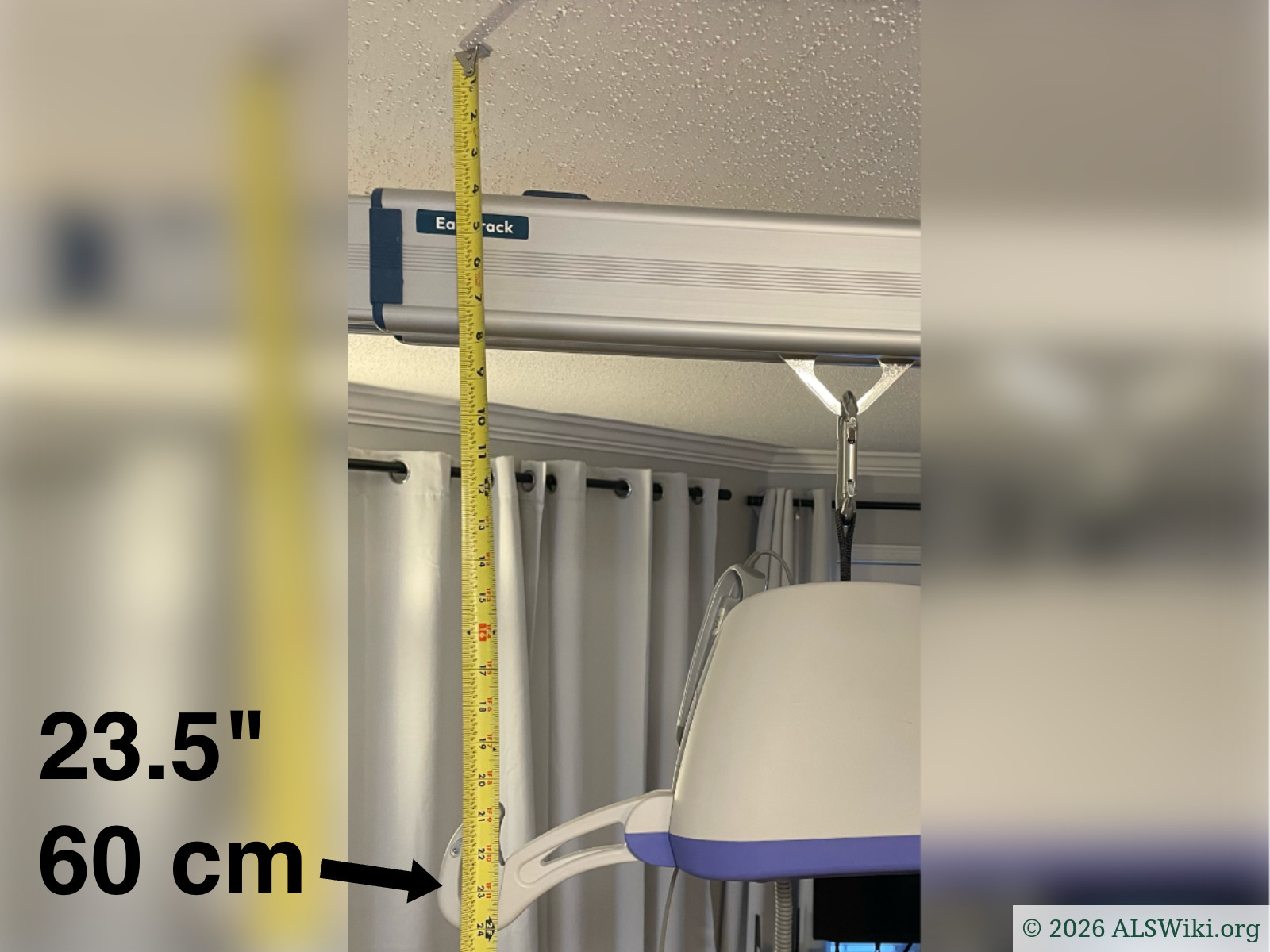
Freestanding track lift with 23.5 inches (60 cm) of vertical distance consumed by ceiling clearance, the height of the frame and trolley, and the upper limit of the lifter's travel distance.
Verify that the lift system has the space needed to operate. Floor lifts must have sufficient clearance from other objects in the room where it is being used. When transferring to a bed, the legs of the lift must be able to go under the bed.
Verify the weight rating of all components of the lift system. The lifter unit, the ceiling track, and any other supporting hardware should have a weight rating that is higher than the weight of the patient.
Table: Comparison of patient lift systemss
| Lift type | Benefits | Drawbacks |
|---|---|---|
| Floor lift (a.k.a. Hoyer lift) |
|
|
| Overhead track lift, mounted to ceiling |
|
|
| Overhead track lift, freestanding |
|
|
¶ Slings
Slings come in a number of different forms, depending upon the patient's level of disability, and the objective of the transfer.
¶ Types
¶ Sit Sling
A sit sling is a type of sling that places the patient in an upright position during the transfer. This is well suited to transfers where the destination is a wheelchair or other place where they will be seated.
Sit slings come in a wide variety of styles and configurations. Some have hard sides, which make placing and removing the sling easier as it tends to maintain its shape. Others are made of thin mesh, which makes them more suited to being left on for longer periods of time, and are more able to get wet since they dry more quickly.
Sit slings also have or omit support for the head and neck.
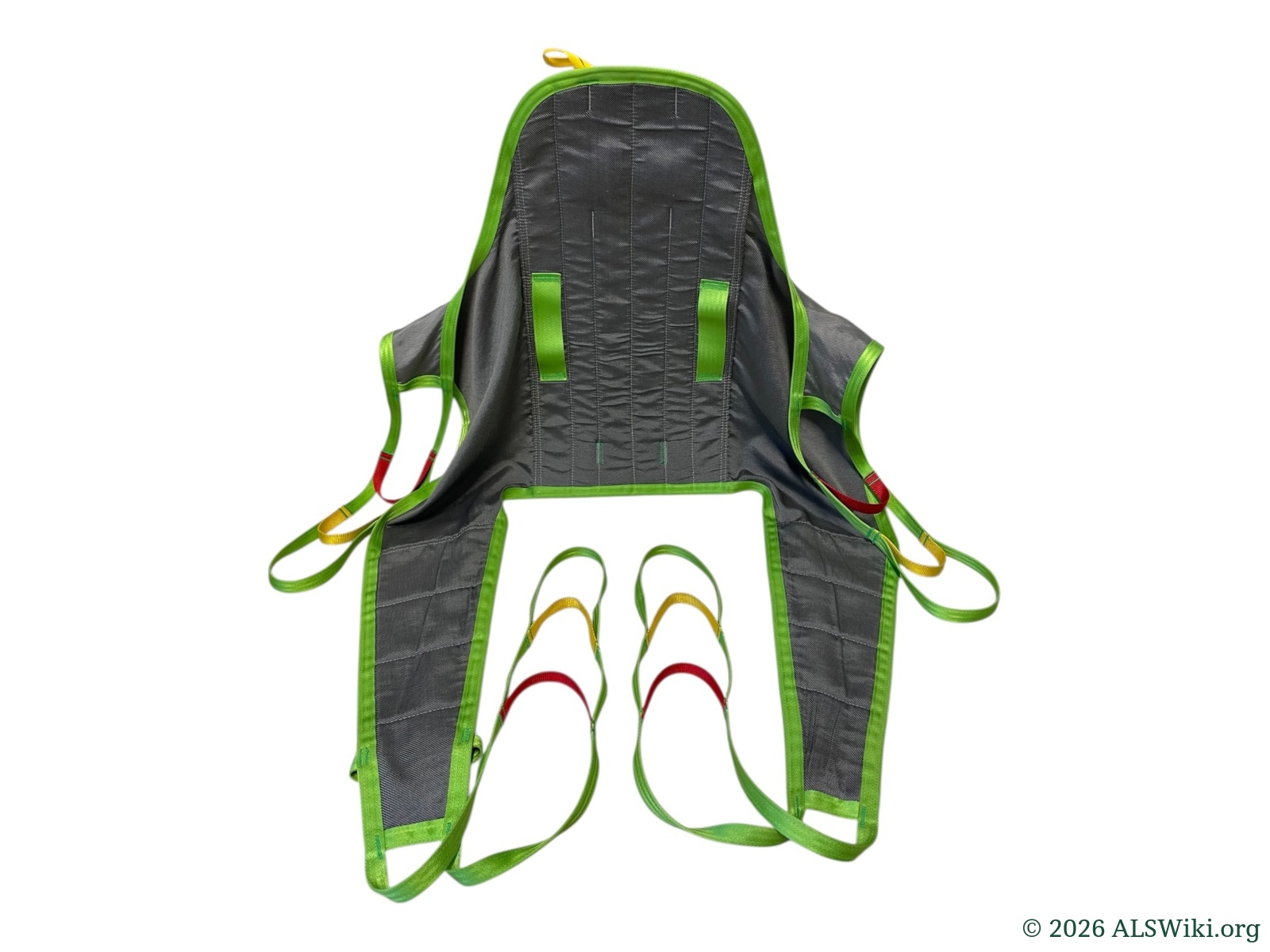
A sit sling with rigid back and sides.
¶ Toileting Sling
A toileting sling is a type of sling ideal for transferring to a toilet. They typically have hard sides, a large open bottom, and padding underneath where the patient's arms go. The patient is kept in an upright position.
Safe use of a toileting sling requires that the patient has adequate strength in their upper body, as some of their weight is borne by them holding their elbows close to their trunk to support themselves within the sling. As such, when an ALS patient no longer has adequate strength in their upper body, a toileting sling is no longer appropriate to use.
¶ Compatibility With Lifts
Lifts and slings must be compatible with one another. Some slings require a spreader bar that projects mounting hooks at a distance from one another, for balance, and to maintain the correct sling shape.
Slings with four mounting loops are typically compatible with any spreader bar type.
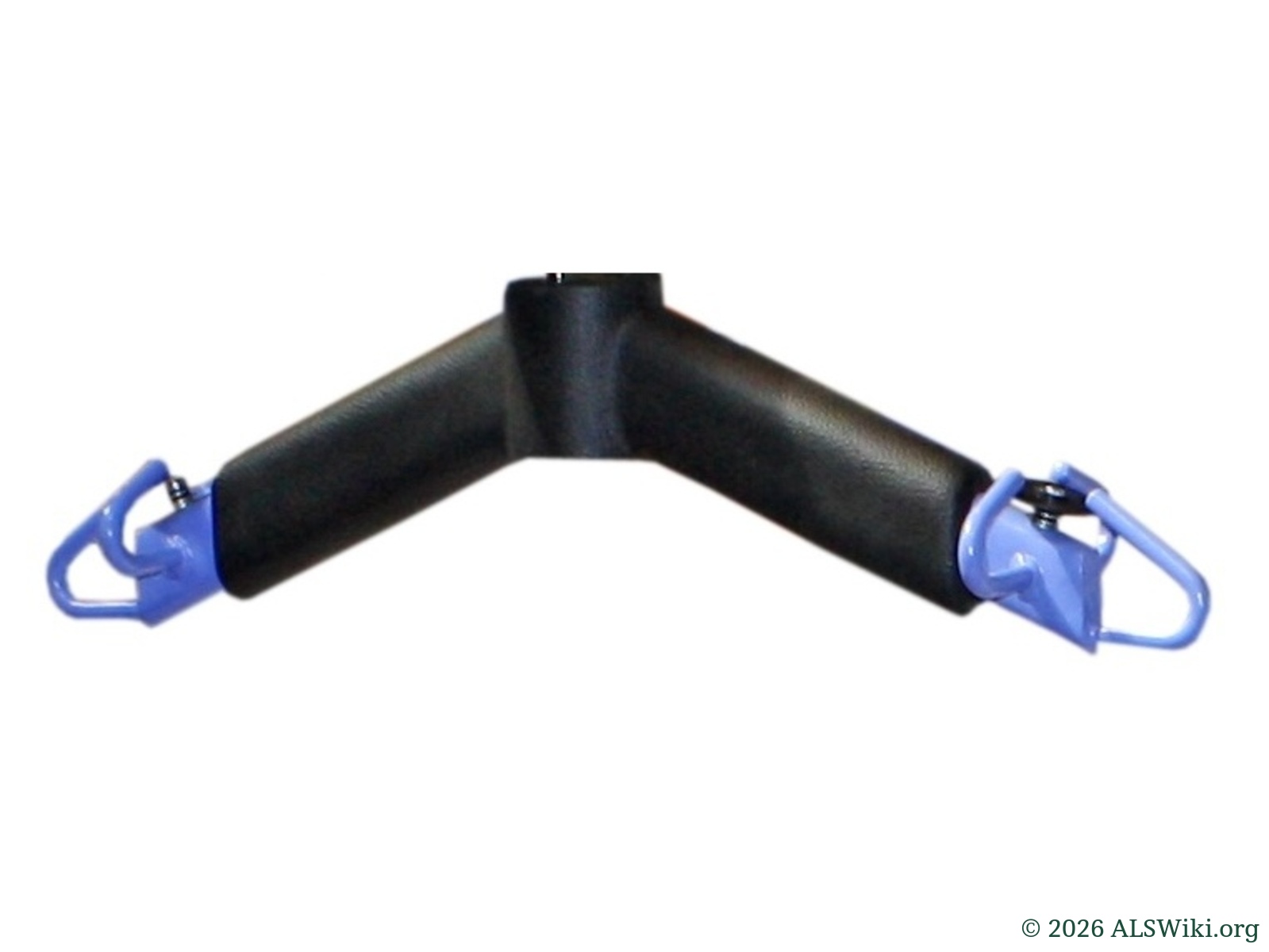
Typical spreader bar with multiple hooks near each other.
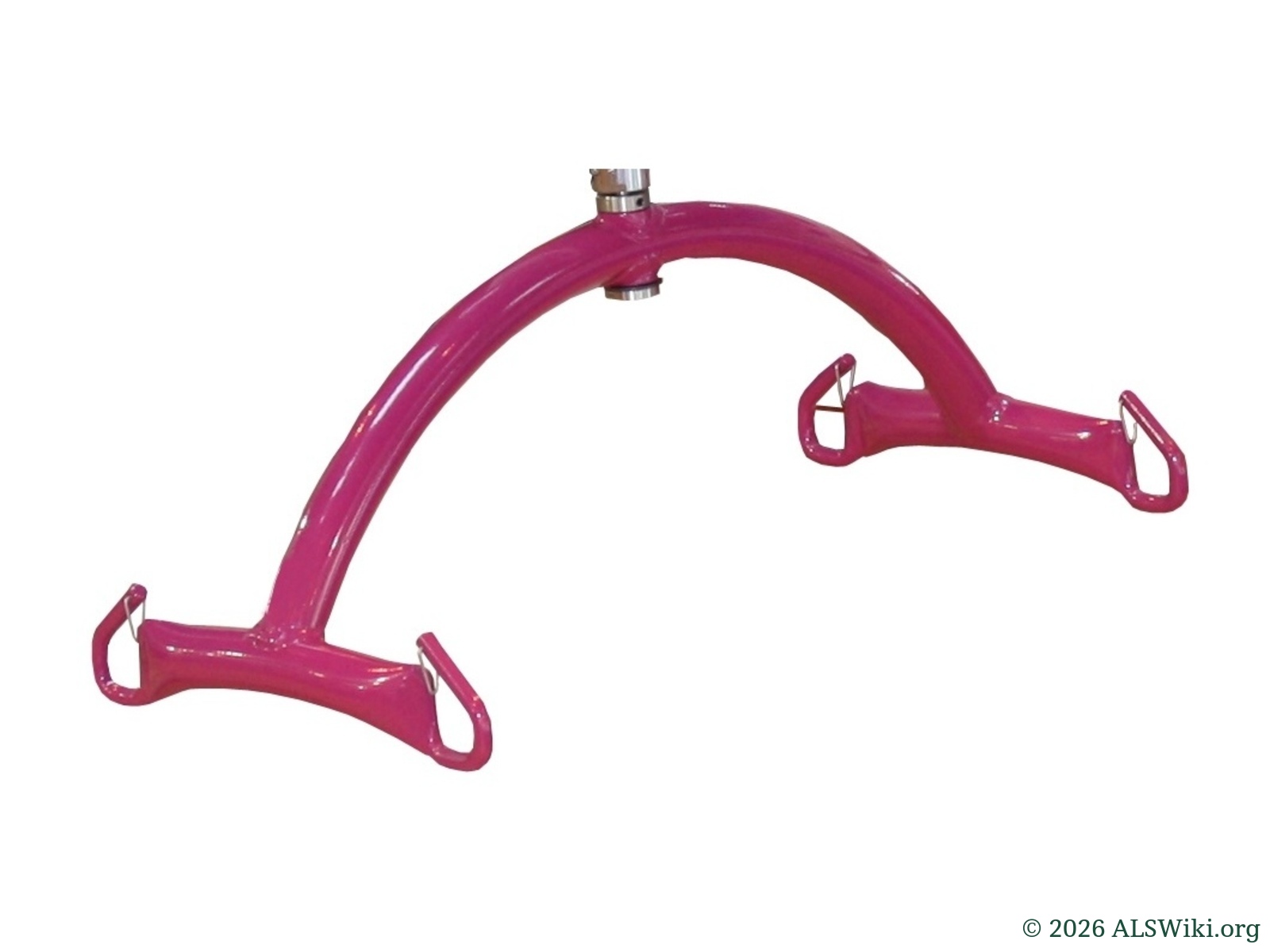
Spreader bar with hooks separated at a distance.
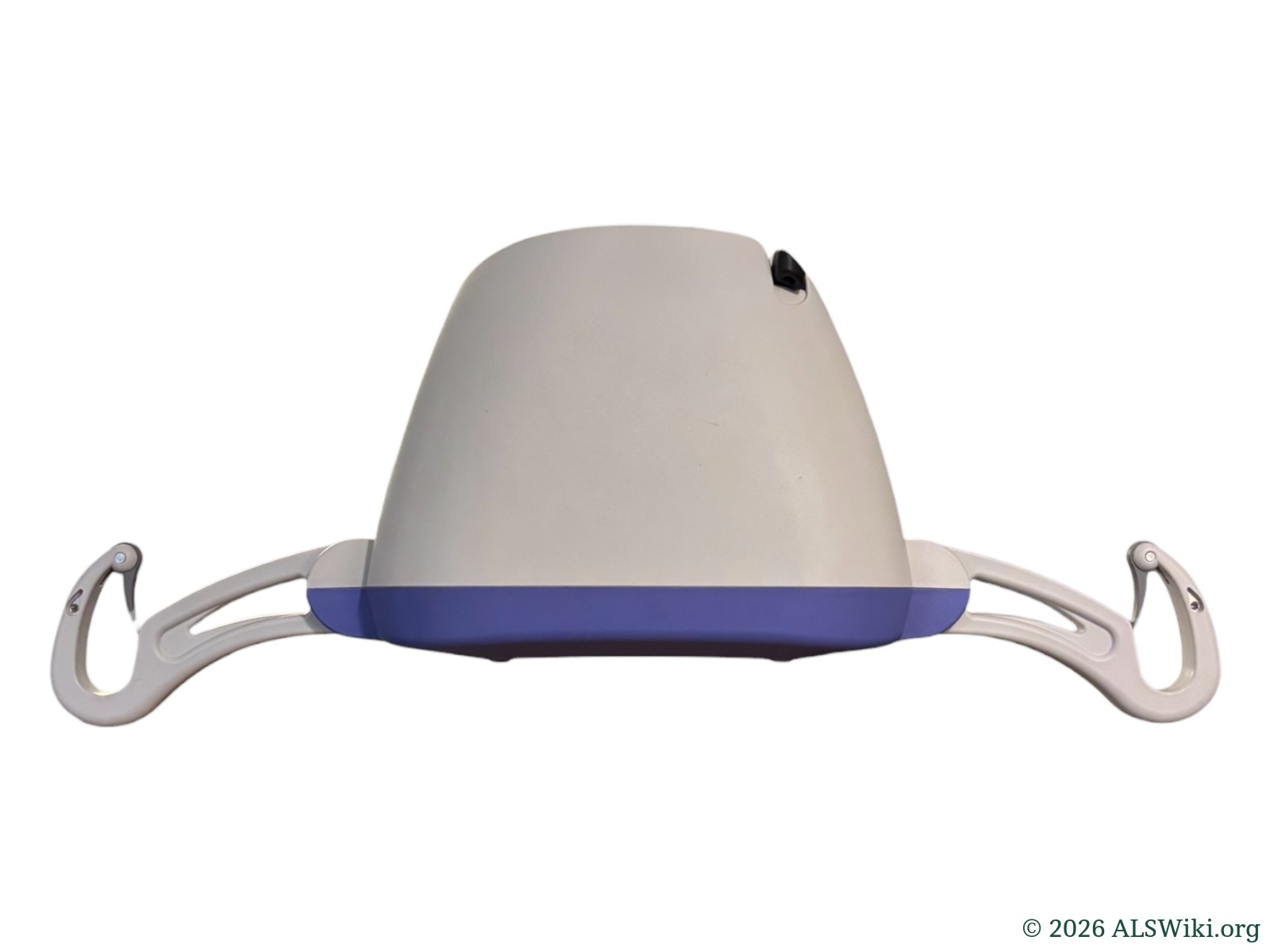
Ceiling lifter with spreader bar as part of the lifting unit itself.
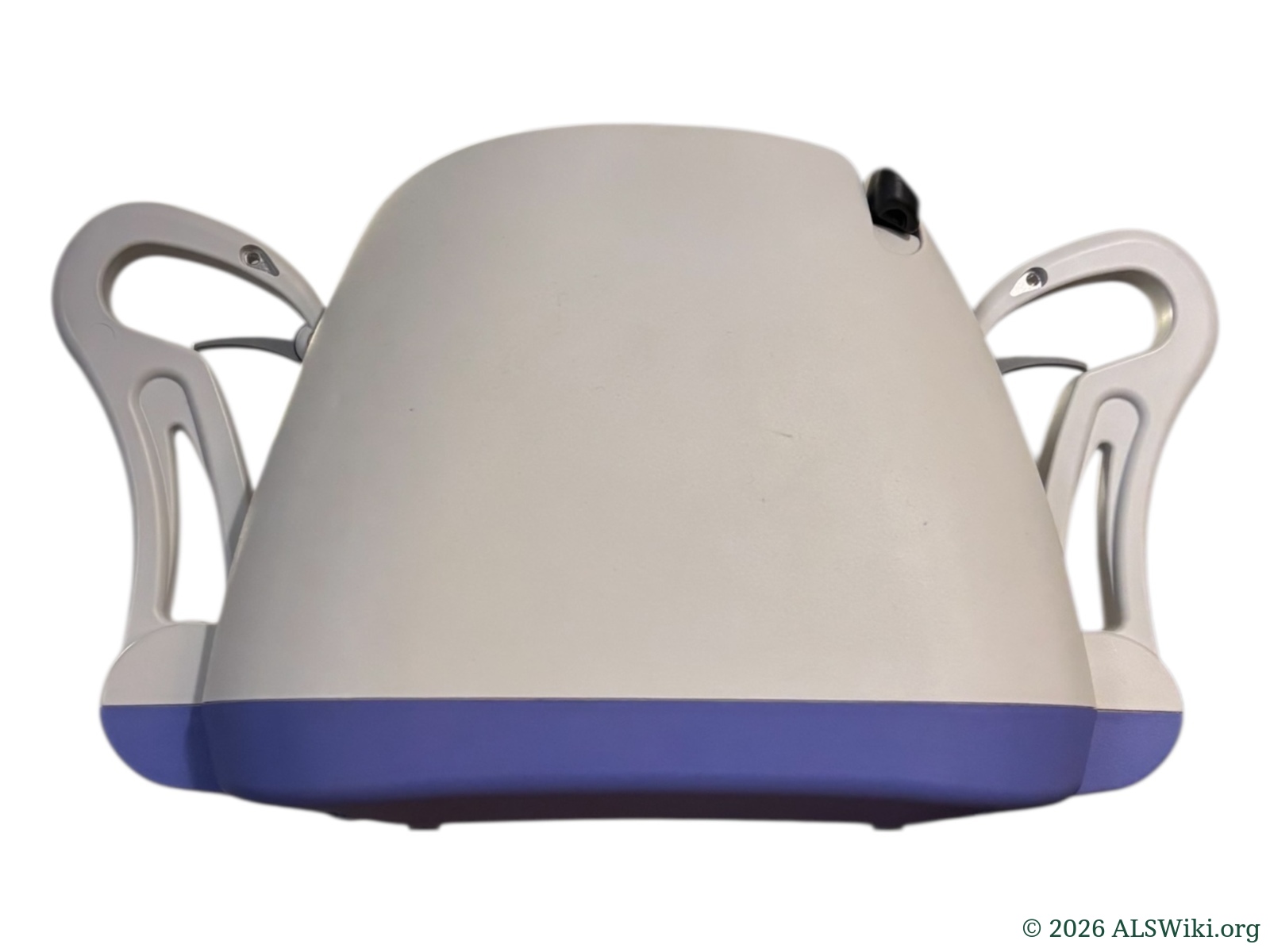
Ceiling lifter with spreader bar hooks folded while not in use.
¶ Further Considerations
Slings should be kept in a discoverable location that is easy to get to promptly, in case of urgent transfers to a toilet or commode chair.
Slings must be cleaned periodically and dried before next use. It is ideal to have multiple slings so that there is always a sling available when one of them is being cleaned or is still drying.
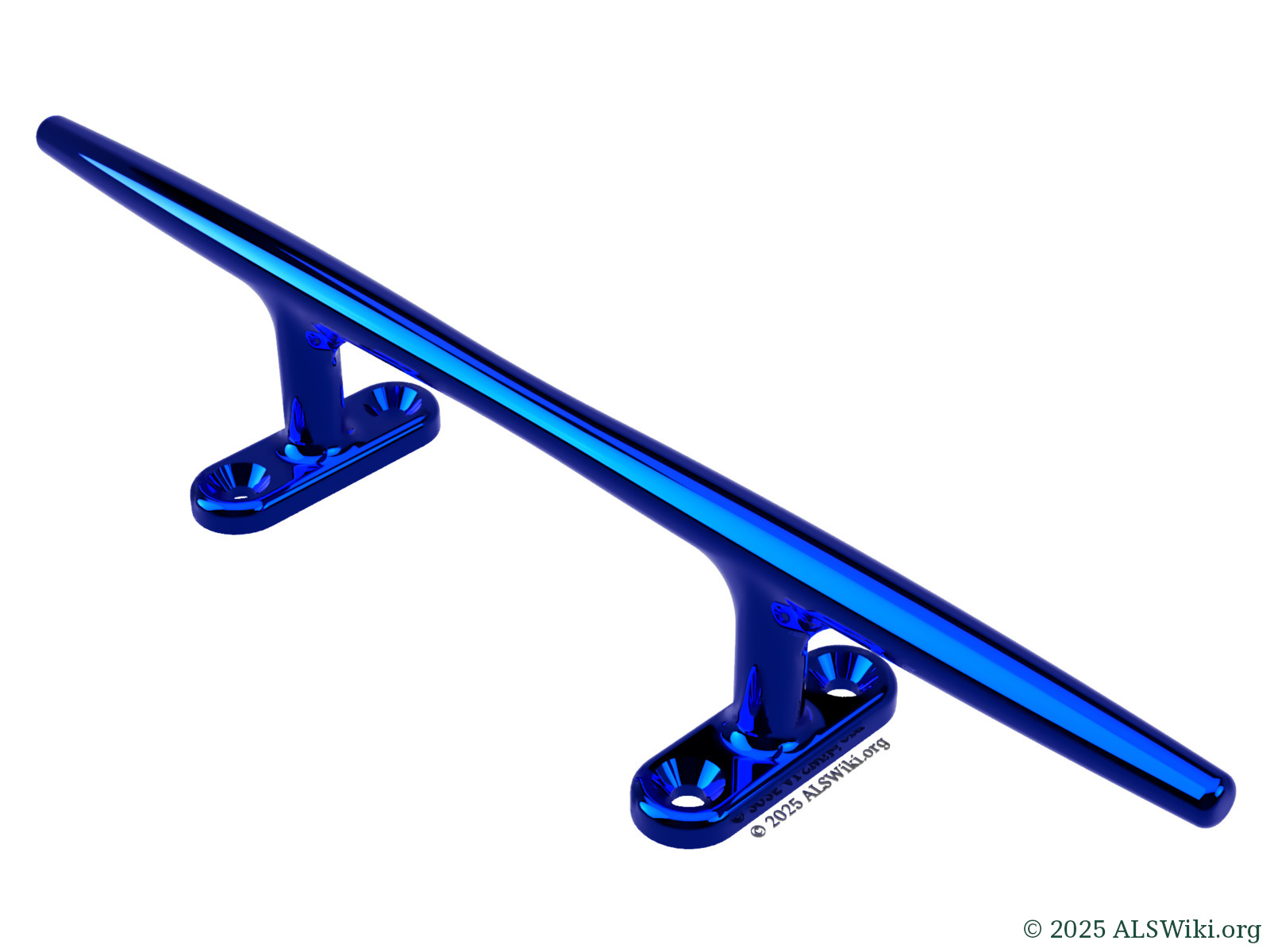
A horn cleat, typically used on boats, can be used to hold a sling neatly on a wall.
¶ Safety
Patient lift systems are generally safe to use when properly set up, well-maintained, and operated by competent individuals.
¶ General
-
Use slings that are properly fitted, and suited to the patient's physical abilities. Some slings require a moderate amount of strength in order to be safely used. For example, toileting slings often require that the patient has some strength in their arm and back muscles to help support some of their own weight.
-
Verify that the sling is properly positioned, and adequately latched to the lifter bar. Most slings have multiple loops which can be used to connect to the lifter bar; sometimes, the wrong loops can get caught in the lifter bar latches. Further, a loop may appear to be properly latched, but may not be.
-
Verify that operators are sufficiently trained and permitted to use the lift. Regulations or home care company policies might mandate that lift operators be formally trained. These policies could require the involvement of two people. If the individual being lifted can operate the lift buttons independently or if an occupational therapist determines they have sufficient bodily control to oversee the lift, they may be counted as the second operator. If this is not the case, a household member may be required to be the second person.
-
Do not push or pull on the patient significantly during landings. It is to be expected that the patient will need to be moved and adjusted slightly to help them land in the correct position at the destination of a transfer. However, the amount of adjustment should be kept to an absolute minimum; large adjustments can cause lift systems to topple over.
¶ Floor lifts
-
Do not use the brakes on a floor lift during a transfer. Floor lifts are fitted with brakes on the wheels. These brakes are intended for preventing the lift from rolling away when not in use. The brakes should never be used during a transfer because movement of the patient may cause the lift to topple over. It is a common misconception that the brakes are supposed to be used during a transfer since it seems intuitive to do so. A small amount of movement of the lift during a transfer is not a problem, so there is no benefit to setting the brakes.
-
Use the floor lift system on suitable floor surfaces only. Floor lifts are not suited to going over thresholds, or on deep pile carpet. The floor lift should be easy to push along the surface upon which it is traveling. Long journeys are not ideal; wheelchairs, wheeled commode chairs, or stretchers are better suited for such a purpose.