¶ Introduction
Grab bars are metal or plastic supports that are mounted to walls or other surfaces to provide a stable handhold during transfers or when walking.
The support provided by grab bars can help someone with ALS maintain stability when they have relatively minor issues with balance. Alternate methods, such as the use of lifts or other transfer equipment become necessary when there is further disease progression.
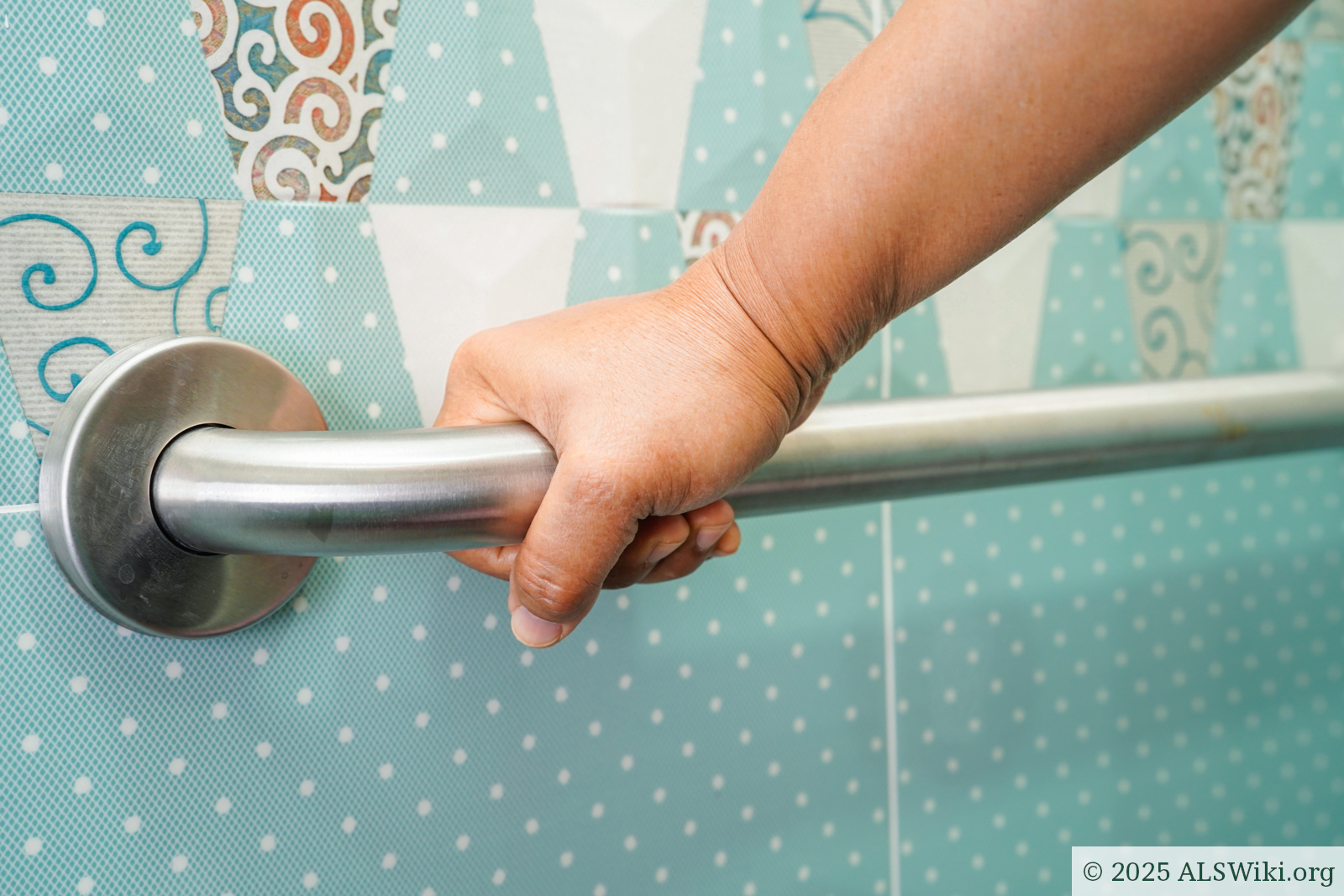
A grab bar mounted to a bathroom wall.
¶ Start using when…
Stability is needed to do a transfer, such as to a bed, toilet, or bathtub, etc. The destination must be in a fixed position relative to where the grab bar is to be mounted on a wall.

¶ Stop using when…
Transferring has become unstable and precarious, despite having the assistance of the grab bar.
¶ Replace with…
Patient Lifts and Slings ݦ Positioning and Installation
Grab bars may be installed anywhere that they are needed. ADA guidelines recommend an installed height of 33 to 36 inches (85-90 cm) from the floor[1].
Grab bars may be used in conjunction with a transfer pole to provide a complete transfer solution.
¶ Further Considerations
Grab bars improve safety for those that require a minor amount of assistance. However, grab bars may paradoxically endanger an ALS patient if the extra support encourages them to make maneuvers that are no longer safe given their level of weakness.
80% of falls within a home occur in the bathroom[2].
Discontinue use of grab bars if they no longer make the transfer completely stable and safe.
Grab bars mount to walls in a variety of different ways. Most use strong screws to go through drywall and attach to a backing plate to distribute load. They can also screw directly into wall studs.
Some models use suction cups to mount to surfaces such as tile. These models are probably not suited to the loads that an ALS patient made one day end up putting on them.
¶ See Also
¶ References
- "Chapter 6: Toilet Rooms", U.S. Access Board - Home, Retrieved 2025-12-30
- "How to prevent falls in the bathroom | UCLA Health", UCLA Health: Center for High Quality Health Care Services, Retrieved 2025-12-30